500+ tons of daily plastic | €200M+ economic impact
Waterways and Airspace Crises
3,500+ annual US drownings | 70% lifeguard shortage
Rising waterway closures | Asymmetric maritime threats
Fluid Motion Robotics (FMR)
FMR is a California based company with close Greek business, engineering and experimental deployment ties. It is rooted in two strategically important coastlines, the Pacific Ocean and the Aegean and Mediterranean Sea. These regions demand resilient, autonomous systems for monitoring, response, and continuous operations across complex environments. FMR mission is to build the hardware and software to meet those demands.
Direction
Vision, mission, and execution roadmap
The Vision
Restore the world's most critical water and land infrastructures.
The Mission
- Deploy water cleaning, airspace and land monitoring at scale.
- Enable GPS-denied operations for UAVs and USVs with onboard AI decision making.
- Surpass market leaders in performance.
The Goals 18 months
- Commercialize DPilot Control and DPilot Horizon AI integration.
- TFV manufacturability, robust DPilot Surf, and mini-scale demos.
- Operations and strategic milestones across the USA and Greece.
Projects
One autonomy stack. Multiple mission profiles
FMR is developing low-cost, deployable robotic systems and autonomy infrastructure for humanitarian response, environmental protection, and resilient mission execution across water, land, and air.
Water / USV
FMR Marine USV
Fully autonomous system
End-to-end mission execution with zero human intervention during operation.
Computer vision
Real-time detection and environmental awareness for floating debris and mission targets.
Fail-safe design
Redundant systems engineered for reliable operation in critical marine environments.
Modular architecture
Adaptable payload and mission design for cleanup, SAR, inspection, and defense use cases.
Embedded Controls
DPilot Controls; Baseboard
Fail-operational controls
Designed for reliable embedded autonomy.
Cross-domain scalability
Scalable platform for USV marine, UAV aerial, and UGV ground robotic systems.
Power Integrity
DPilot Controls; Power Module
No Single Point Failure (SPF) design
Architected to avoid single points of failure across the power system.
Dual power inputs
Redundant battery sources maintain system availability during abnormal power events.
Power redundancy
Redundant high-current and low-current paths for propulsion and control electronics.
Onboard monitoring
Real-time status, voltage, current, and temperature monitoring for system health visibility.
Software Platform
DPilot Horizon
Semi-autonomous operation
Operators select the route while missions stream to the vehicle in flight, enabling live route edits.
Localization
EKF fuses IMU, compass, and GPS into a continuous estimate of position, velocity, and attitude.
Dead reckoning
IMU-based estimation maintains continuity between GPS updates.
Motion control
Hybrid authority architecture blends operator commands with onboard stabilization and flight controllers.
DPilot in action
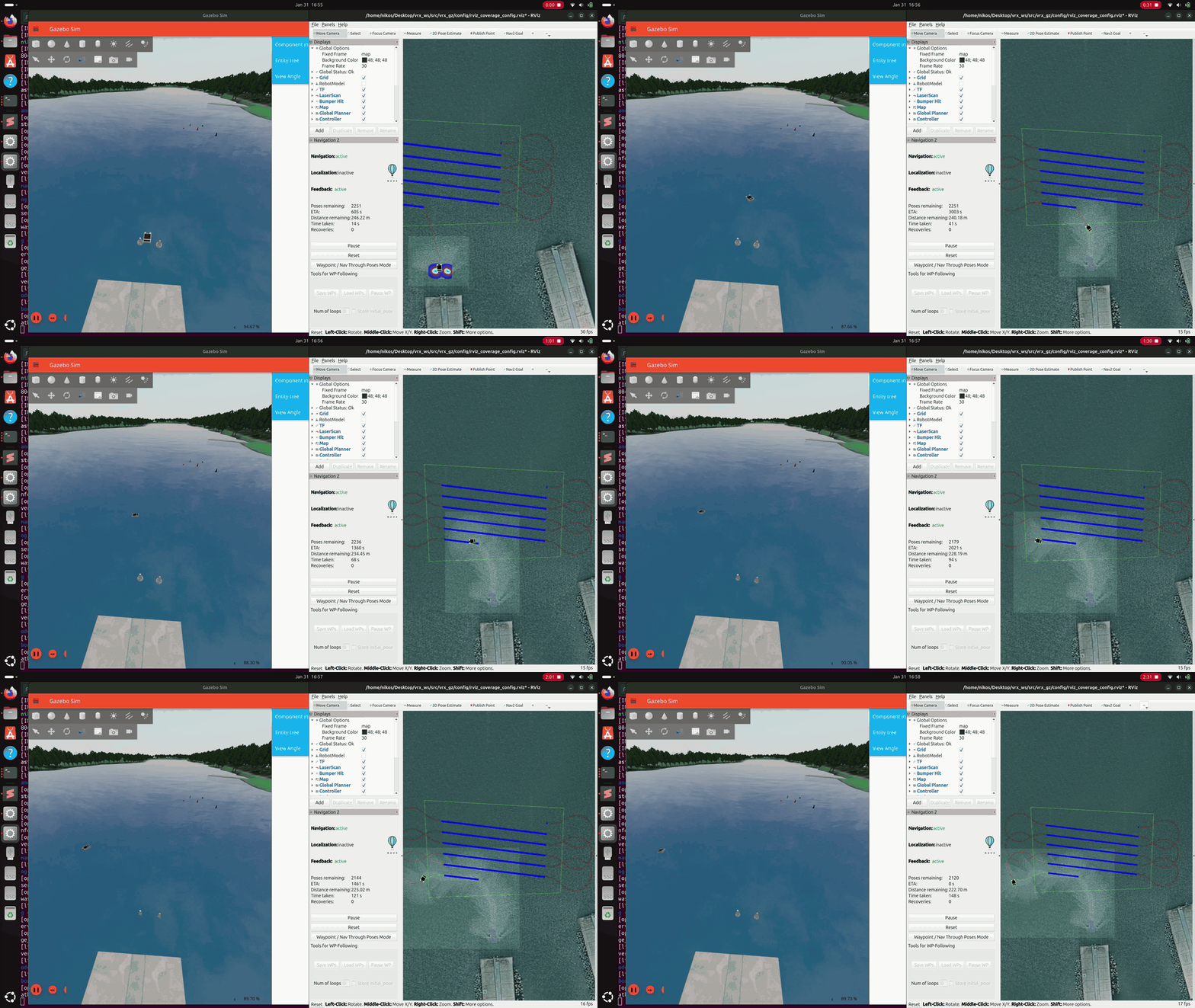
ROS2 Closed-Loop Simulation (Nav2 + RViz + Coverage)
This simulation runs the Trash Feaster mission in closed loop using ROS2, Nav2, RViz, and a coverage algorithm implementing DPilot waypoint missions. In closed loop, the controller continuously reads state feedback and updates commands during execution.
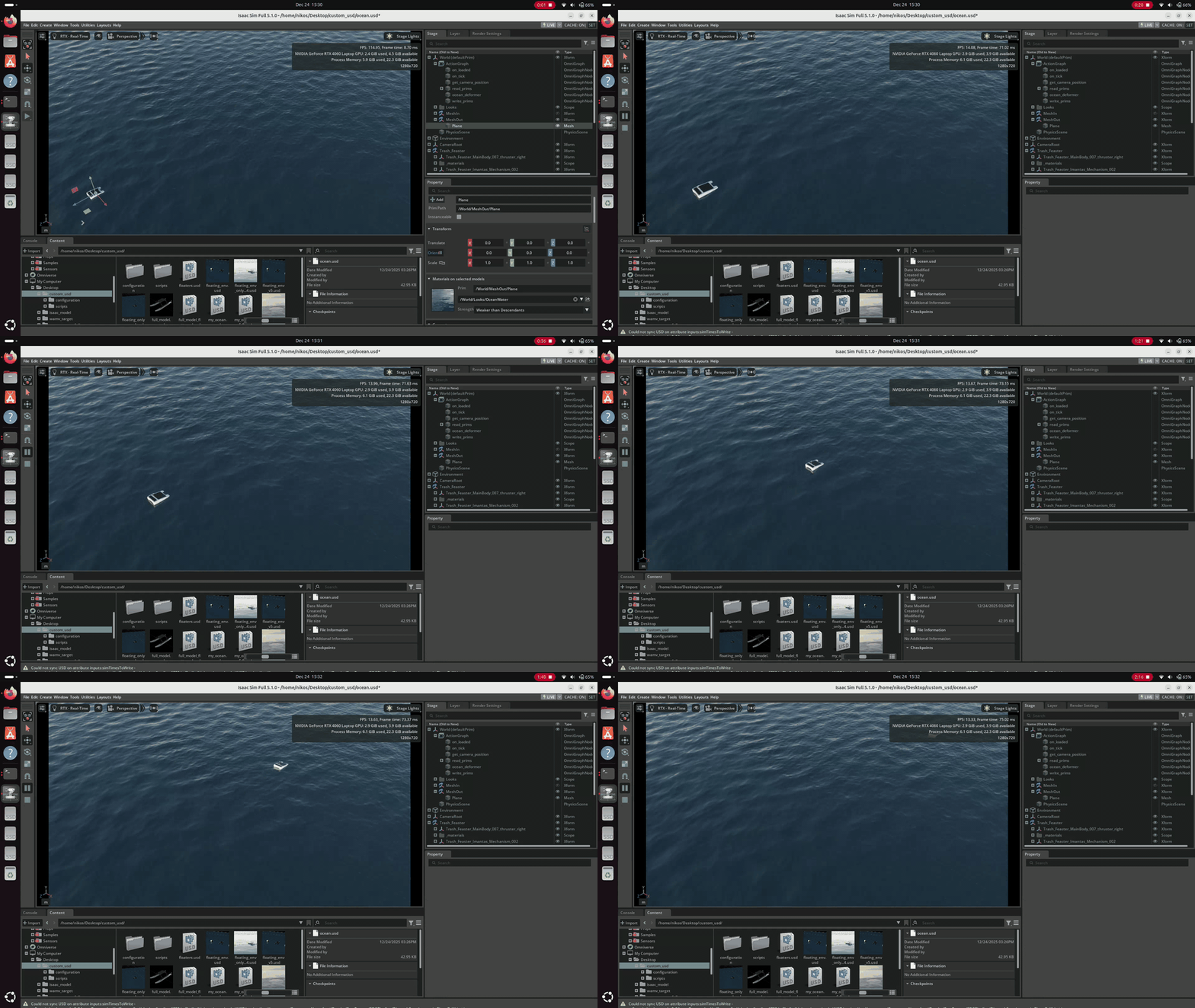
Isaac Sim Open-Loop Physics Simulation
This NVidia Isaac Sim clip focuses on the Trash Feaster vehicle physics in open loop. In open loop, command inputs are applied without mission-level feedback correction, which is useful for isolating and validating baseline dynamics.

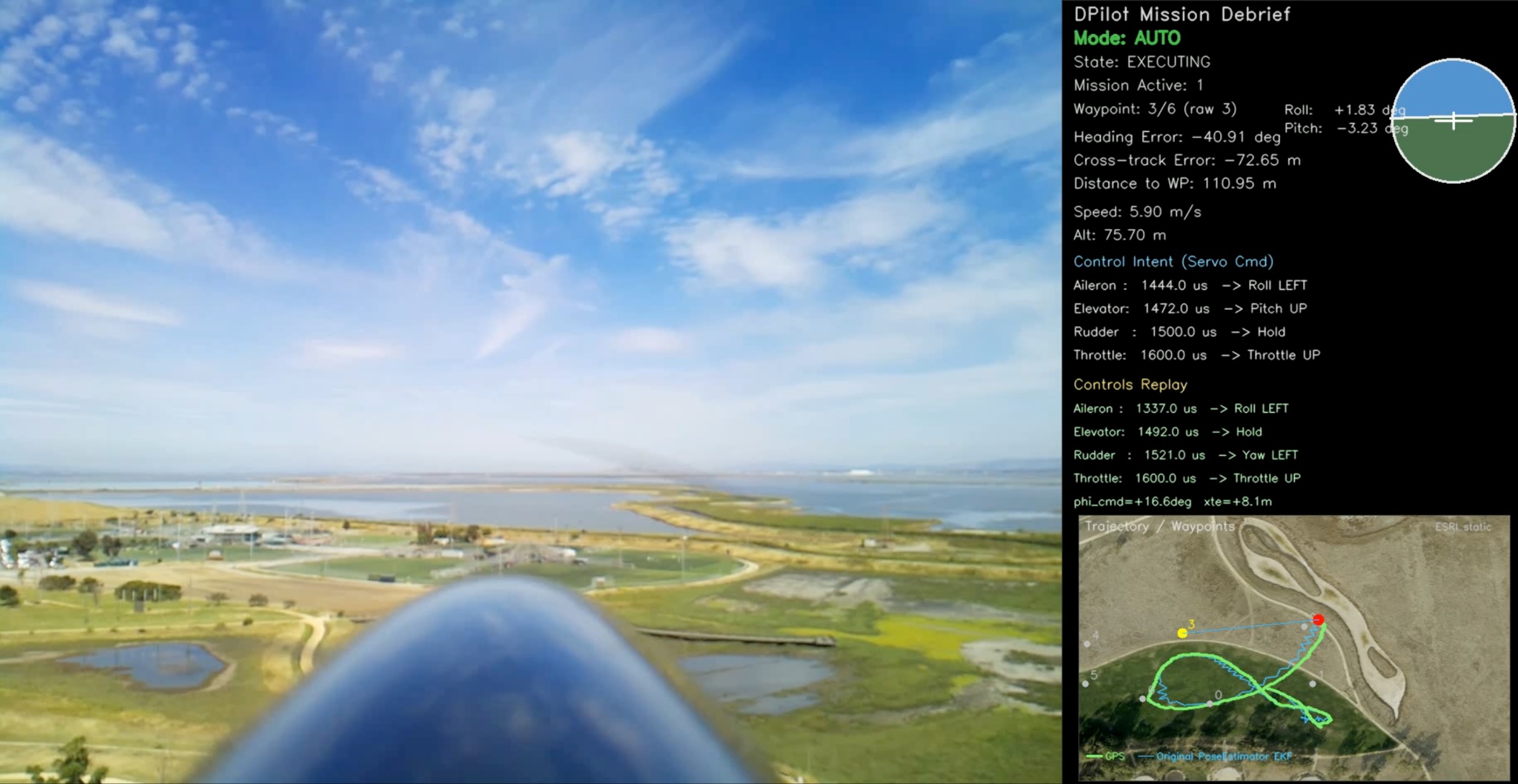
Real Flight Mission — Sunnyvale Baylands, April 2026
Annotated debrief of a DPilot UAV flight at Baylands Park, Sunnyvale, California. Three segments are shown: manual take-off, autonomous cruising mode, and mixed-mode landing. Log replay functionality that enables the development of localization, motion planning and motion control (flight control) algorithms using logged test data.
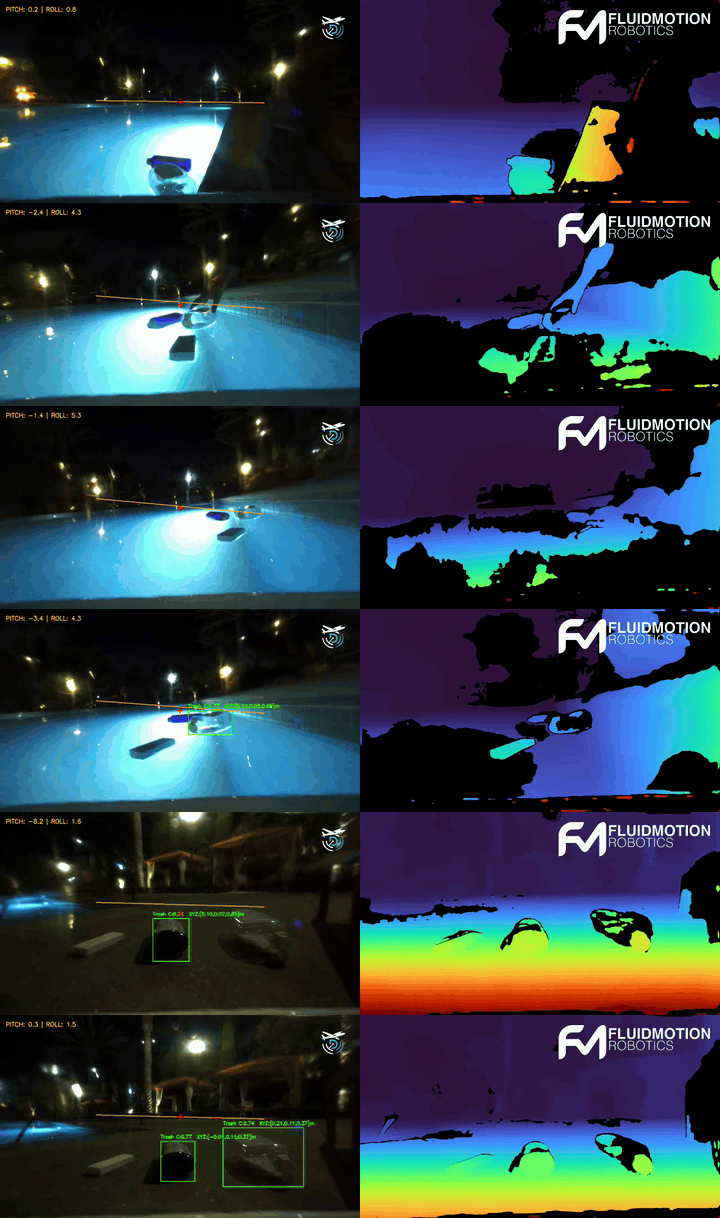
DPilot Surfer Vision — Jetson TensorRT Test
Custom YOLO/SSD model trained on Taco datasets and accelerated by TensorRT on Jetson hardware. A Zed 2i stereo Camera is used for depth estimation. Limited lighting tests stressing trash detection.
Team
Built by engineers
A multidisciplinary team focused on hardware, systems, software, and controls — built for real needs and real applications.
Contact / Collaboration
Partner with FluidMotion Robotics
We are looking for pilot partners and collaborators who care about practical, low-cost robotics for humanitarian and earth-system applications. We are always open to learning through real-world deployments.